
MOSS-TTS#
MOSS-TTS-v1.5 is a delay-pattern text-to-speech model from MOSI.AI and the OpenMOSS team. It reconstructs 24 kHz speech and supports zero-shot voice cloning from reference audio, reference-less synthesis, long-form speech generation, streaming, token-level duration control, Pinyin/IPA pronunciation control, multilingual synthesis, and code-switching. The model supports 31 languages, accepts language tags to guide multilingual generation, and supports inline pause markers such as [pause 3.2s] for explicit prosody control.
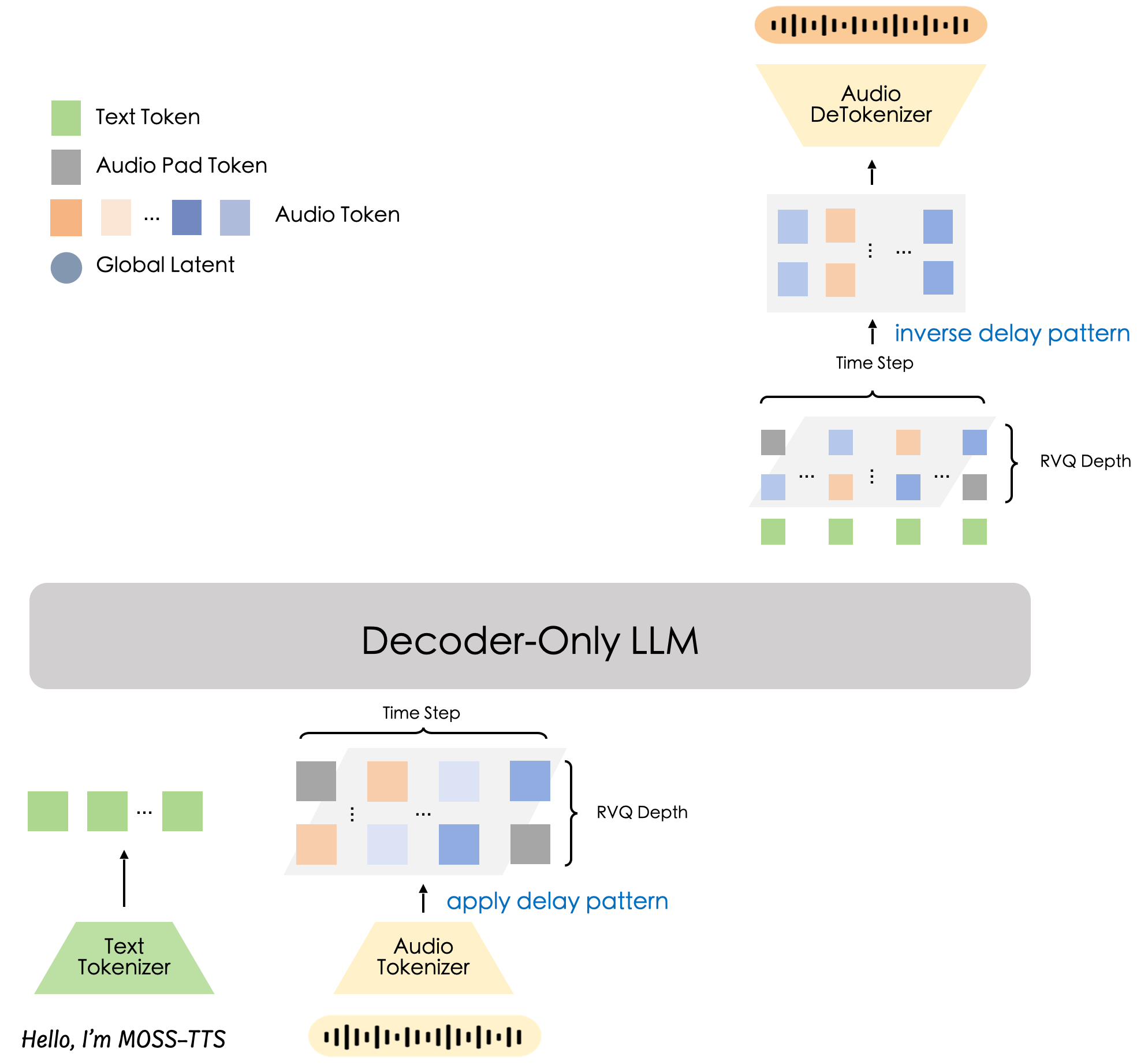
Architecturally, MOSS-TTS-v1.5 is the delay-pattern counterpart to MOSS-TTS-Local-Transformer-v1.5. The Qwen3-8B backbone predicts one text stream plus 32 residual-vector-quantization (RVQ) audio codebooks with delay-pattern scheduling; the generated codes are de-delayed and reconstructed into waveform by the vocoder. In SGLang-Omni it runs as a preprocessing → tts_engine → vocoder pipeline served through the OpenAI-compatible /v1/audio/speech endpoint.
Component |
Spec |
|---|---|
Architecture |
|
Backbone |
Qwen3-8B autoregressive decoder (36 L, hidden=4096, GQA 32/8) |
Audio tokens |
32-codebook RVQ depth with delay-pattern scheduling |
Output audio |
24 kHz |
Languages |
31 languages with optional language tags |
Controls |
Voice reference, target duration tokens, Pinyin/IPA, pause markers, style instructions |
Prerequisites#
Install sglang-omni by following Installation, then
download the model (public, no token required):
hf download OpenMOSS-Team/MOSS-TTS-v1.5
The processor ships with the checkpoint, so no extra TTS package is needed. Decoding base64
(data-URI) reference audio additionally requires soundfile (uv pip install soundfile).
Server Configuration#
The pipeline is preprocessing → tts_engine → vocoder. By default the vocoder
runs in its own process (GPU memory fractions 0.10 / 0.72 / 0.18 for the three
stages): its Python decode loop no longer shares the interpreter with the AR
scheduler, which on H200 lifts single-replica throughput by about 70% at every
concurrency cap. config_cls: MossTTSSingleProcessPipelineConfig restores the
single-process layout; the bounded 24 GB and 32 GB configurations keep it.
sgl-omni serve \
  --model-path OpenMOSS-Team/MOSS-TTS-v1.5 \
  --config examples/configs/moss_tts.yaml \
  --port 8000
The default model-specific layout places the repository-local encoder and
vocoder components on the configured pipeline GPU. The encoder and decoder
weights materialize in BF16 according to compute_dtype; the quantizers and
explicit FP32 norms remain in FP32. Each stage constructs only the codec
components it uses instead of loading a complete codec copy.
The bounded 24 GB and 32 GB configurations explicitly move preprocessing to
CPU. They retain BF16 compute unless compute_dtype is overridden.
Speech input admission follows the text backbone’s context metadata rather than the generic 4,096-character precheck. Requests that exceed the effective model context are rejected with an OpenAI-compatible HTTP 400 error.
For the bounded 32 GB qualification layout, use:
sgl-omni serve \
  --model-path OpenMOSS-Team/MOSS-TTS-v1.5 \
  --config examples/configs/moss_tts_32gb.yaml \
  --port 8000
This configuration limits request concurrency and CUDA Graph capture to batch size 1. It completed startup and reference-less non-streaming synthesis on one RTX 5090 with 32,607 MiB, peaking at 26,939 MiB. Treat this as a measured qualification point rather than a general claim for every 32 GB card.
For the directly measured 24 GB layout, use:
sgl-omni serve \
  --model-path OpenMOSS-Team/MOSS-TTS-v1.5 \
  --config examples/configs/moss_tts_24gb.yaml \
  --port 8000
This profile completed startup, CUDA Graph capture, reference and
reference-less synthesis, streaming, cancellation, and recovery on one RTX
4090 with 24,564 MiB. Peak sampled VRAM was 23,251 MiB, leaving a minimum of
960 MiB free. SGLang profiled an effective 6,708-token KV capacity below the
requested max_total_tokens: 8192. Treat this as a concurrency-1,
CUDA-Graph-cap-1 qualification point, not a broader 24 GB capacity claim.
Both policies can be changed explicitly through the preprocessing/vocoder
stages’ factory.* entries when profiling another layout. Explicit device
values take precedence over the GPU selected by stage placement.
Synthesizing Speech#
Basic Speech#
MOSS-TTS can synthesize speech without a reference clip:
curl -X POST http://localhost:8000/v1/audio/speech \
  -H "Content-Type: application/json" \
  -d '{
    "model": "OpenMOSS-Team/MOSS-TTS-v1.5",
    "voice": "default",
    "input": "SGLang-Omni is a great project!"
  }' \
  --output output.wav
Voice Cloning#
Provide a reference clip when you want voice cloning. The references field accepts audio_path
(a local path, HTTP URL, or base64 data URI) and text (the transcript of that clip). Supplying
the transcript materially improves cloning quality.
curl -X POST http://localhost:8000/v1/audio/speech \
  -H "Content-Type: application/json" \
  -d '{
    "model": "OpenMOSS-Team/MOSS-TTS-v1.5",
    "voice": "default",
    "input": "SGLang-Omni is a great project!",
    "references": [{
      "audio_path": "https://huggingface.co/datasets/zhaochenyang20/seed-tts-eval-mini/resolve/main/en/prompt-wavs/common_voice_en_10119832.wav",
      "text": "We asked over twenty different people, and they all said it was his."
    }]
  }' \
  --output output.wav
ref_audio and ref_text are accepted as shorthand for references[0].audio_path and
references[0].text.
Python
import requests

resp = requests.post(
    "http://localhost:8000/v1/audio/speech",
    json={
        "model": "OpenMOSS-Team/MOSS-TTS-v1.5",
        "voice": "default",
        "input": "Get the trust fund to the bank early.",
        "ref_audio": "https://huggingface.co/datasets/zhaochenyang20/seed-tts-eval-mini/resolve/main/en/prompt-wavs/common_voice_en_10119832.wav",
        "ref_text": "We asked over twenty different people, and they all said it was his.",
    },
)
resp.raise_for_status()
with open("output.wav", "wb") as f:
    f.write(resp.content)
Reference Audio Sources#
audio_path / ref_audio may be a local filesystem path readable by the server, an HTTP(S)
URL, or a base64 data URI (data:audio/wav;base64,<...>, decoded with soundfile):
{"ref_audio": "data:audio/wav;base64,UklGR.....", "ref_text": "Transcript of the clip."}
Streaming#
Set "stream": true and "response_format": "pcm" to receive raw PCM audio
chunks in real time.
curl -N -X POST http://localhost:8000/v1/audio/speech \
  -H "Content-Type: application/json" \
  -d '{
    "model": "OpenMOSS-Team/MOSS-TTS-v1.5",
    "voice": "default",
    "input": "Get the trust fund to the bank early.",
    "ref_audio": "https://huggingface.co/datasets/zhaochenyang20/seed-tts-eval-mini/resolve/main/en/prompt-wavs/common_voice_en_10119832.wav",
    "ref_text": "We asked over twenty different people, and they all said it was his.",
    "stream": true,
    "response_format": "pcm"
  }' \
  --output output.pcm
Duration Control#
MOSS-TTS conditions on a target duration token count (codec frames; a larger count yields
longer audio). Set it with an inline ${token:N} prefix on input (stripped before synthesis),
or with a token_count (alias duration_tokens / tokens) parameter. The count must be a
positive integer.
{
  "model": "OpenMOSS-Team/MOSS-TTS-v1.5",
  "voice": "default",
  "input": "${token:150}A sentence with an explicit duration target.",
  "ref_audio": "..."
}
If omitted, the model picks a duration on its own; the SeedTTS benchmark estimates one per
sample with --token-count auto.
Text Markup, Style, and Language#
Inline text markup that the model understands (for example [pause Xs], pinyin, and IPA) is
passed through unchanged. An optional instructions (alias instruct) field carries a
free-text style directive, and an optional language hint biases the target language (omit it
to let the model infer from the text):
{
  "model": "OpenMOSS-Team/MOSS-TTS-v1.5",
  "voice": "default",
  "input": "今天天气不错 [pause 0.5s] 就该出去晒晒太阳。",
  "ref_audio": "...", "ref_text": "...",
  "language": "Chinese",
}
Generation Parameters#
Parameter |
Default |
Notes |
|---|---|---|
|
served model |
Served model identifier |
|
(required) |
Text to synthesize. It may carry a |
|
|
Voice identifier |
|
|
Reference clip for cloning. Each item has |
|
|
Shorthand for |
|
|
Stream raw PCM audio chunks |
|
|
Optional target-language hint. Omit to let the model infer |
|
|
Optional free-text style directive |
|
|
Target duration in codec frames. It must be |
|
|
Maximum generated frames. An explicit value must be |
|
|
Sampling temperature. A single |
|
|
Top-p sampling. A single |
|
|
Top-k sampling. A single |
|
|
Audio repetition penalty |
|
|
Non-negative integer. See Seed Reproducibility |
The per-channel fields (text_temperature, audio_temperature, text_top_p, audio_top_p,
text_top_k, audio_top_k, audio_repetition_penalty) are also accepted and take precedence
over the single-value aliases.
Seed Reproducibility#
MOSS-TTS samples each row, position, and codebook with multinomial_with_seed, deriving a
per-request seed from the public seed and combining it with a per-(step, channel) position. A
sampled token therefore depends only on its own seed and position — never on its batch
neighbours — so a fixed seed is reproducible at any concurrency, not just batch size 1.
Limitations:
Reproducibility holds for a fixed server configuration and hardware. Floating-point non-determinism in the backbone (different batch shapes, GPU models, or kernels) can still change the logits, and thus the sampled tokens, across deployments.
seedmust be a non-negative integer; non-integer or negative values are rejected.Requests without a
seeddraw a fresh random per-request seed, so they are not reproducible across runs (but are still independent of batch neighbours).
Benchmarking#
MOSS-TTS clones from each prompt (--ref-format references) and estimates a per-sample duration
with --token-count auto. Run at --max-concurrency 8; higher concurrency regresses WER.
python -m benchmarks.eval.benchmark_tts_seedtts \
  --meta zhaochenyang20/seed-tts-eval-arrow \
  --model OpenMOSS-Team/MOSS-TTS-v1.5 --port 8000 \
  --ref-format references --token-count auto \
  --output-dir results/moss_tts_en --lang en --max-concurrency 8
Use --lang zh for the Chinese split. See benchmarks/README.md for the full workflow.
Benchmark Results#
Seed-TTS-Eval full set (EN = 1088, ZH = 2020) on 1× H200, concurrency 8, --token-count auto.
WER is scored with HF Whisper-large-v3 (EN) / FunASR paraformer-zh (ZH). These are the reference
numbers tabulated in benchmarks/eval/benchmark_tts_seedtts.py (source: PR #609) — reproducible
references, not CI thresholds.
Lang |
WER (corpus) |
WER (excl. >50%) |
Latency mean / p95 (s) |
RTF mean |
Throughput (qps) |
|---|---|---|---|---|---|
EN |
1.68% |
1.32% (4 outliers) |
3.449 / 4.141 |
0.811 |
2.312 |
ZH |
1.36% |
1.27% (2 outliers) |
3.608 / 4.153 |
0.635 |
2.213 |
A handful of utterances run away into a repetition loop (> 50% WER) and dominate the raw micro-average; excluding them, corpus WER is ~1.3% in both languages, and per-sample median WER is 0.00%.
Known Limitations#
Voice cloning depends on the reference. Omit the reference for non-cloned speech; provide the transcript (
text/ref_text) for the best speaker similarity when cloning.Concurrency vs. WER. Quality is best around
--max-concurrency 8; higher concurrency regresses WER.Rare runaway generation. A small fraction of utterances can loop and generate up to
max_new_tokens; setting atoken_count(or loweringmax_new_tokens) bounds the output.Duration is a hint.
${token:N}/token_countsteers length but is not an exact clip duration.