
MOSS-TTS-Local#
MOSS-TTS-Local-Transformer-v1.5 is a text-to-speech model from MOSI.AI and the OpenMOSS team. It generates native 48 kHz stereo speech with MOSS-Audio-Tokenizer-v2 and supports zero-shot voice cloning from reference audio, reference-less synthesis, long-form speech generation, streaming, token-level duration control, Pinyin/IPA pronunciation control, multilingual synthesis, and code-switching. The model supports 31 languages, accepts language tags to guide multilingual generation, and supports inline pause markers such as [pause 3.2s] for explicit prosody control.
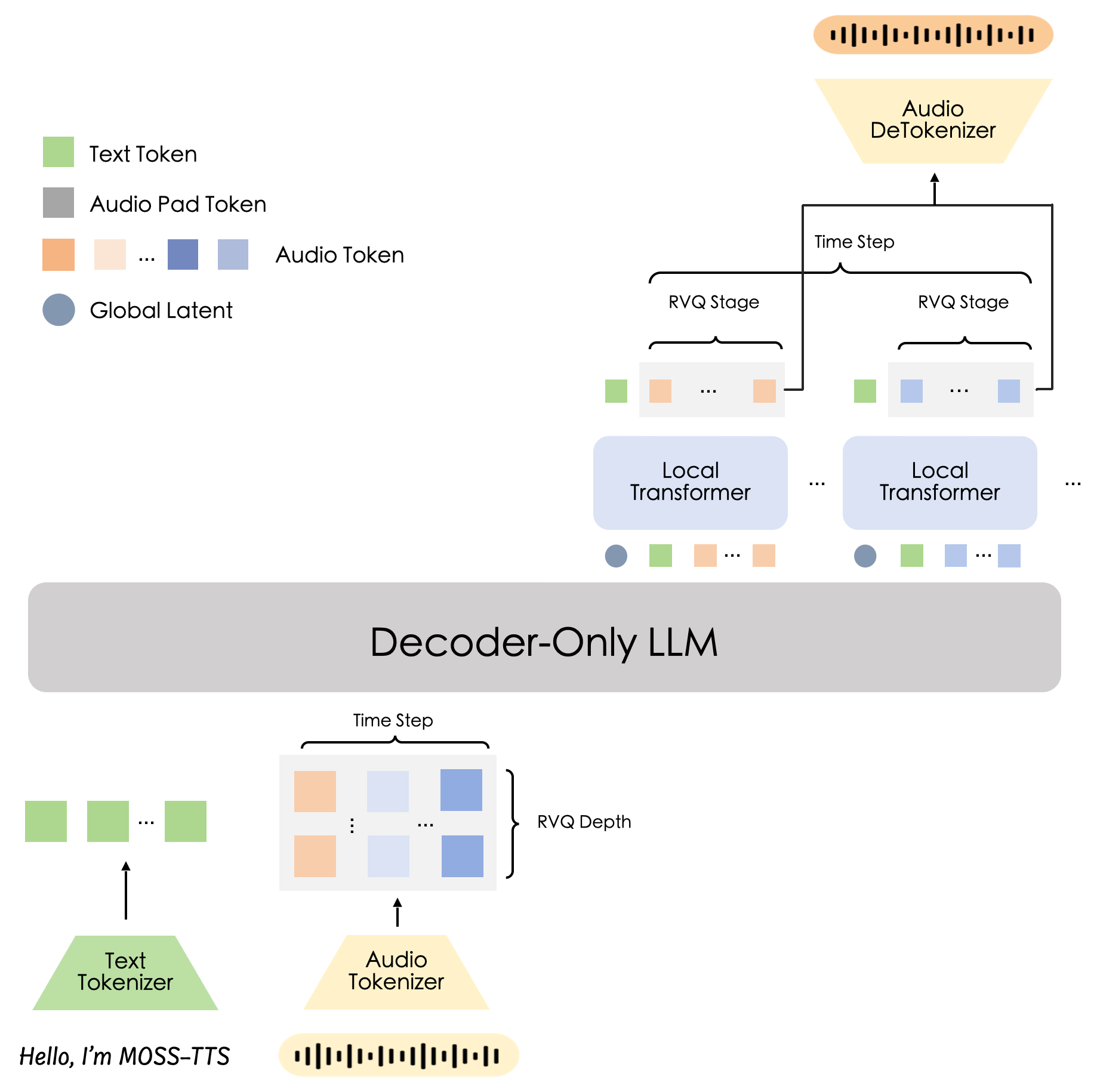
Architecturally, MOSS-TTS-Local-Transformer-v1.5 is the local-transformer counterpart to the delay-pattern MOSS-TTS-v1.5. Instead of staggering RVQ streams across time, the Qwen3-4B backbone emits a global latent for each aligned audio frame, and a lightweight frame-local transformer expands that latent into a fixed 12-codebook RVQ block. In SGLang-Omni it runs as a preprocessing → tts_engine → vocoder pipeline served through the OpenAI-compatible /v1/audio/speech endpoint.
Component |
Spec |
|---|---|
Architecture |
|
Backbone |
Qwen3-4B autoregressive decoder (36 L, hidden=2560, GQA 32/8) |
Audio tokenizer |
MOSS-Audio-Tokenizer-v2 |
Audio tokens |
Fixed 12-codebook RVQ depth |
Output audio |
48 kHz stereo |
Languages |
31 languages with optional language tags |
Controls |
Voice reference, target duration tokens, Pinyin/IPA, pause markers, style instructions |
Prerequisites#
Install sglang-omni by following Installation, then
download the model (public, no token required):
hf download OpenMOSS-Team/MOSS-TTS-Local-Transformer-v1.5
The processor ships with the checkpoint, so no extra TTS package is needed. Decoding base64
(data-URI) reference audio additionally requires soundfile (uv pip install soundfile).
Server Configuration#
The default layout runs preprocessing, the AR backbone, and the vocoder in
separate processes on the same GPU. MPS defaults to auto, enabling CUDA MPS
when the device and process layout support it:
sgl-omni serve \
  --model-path OpenMOSS-Team/MOSS-TTS-Local-Transformer-v1.5 \
  --port 8000
A matching config file is available at examples/configs/moss_tts_local.yaml.
Speech input admission follows the text backbone’s context metadata rather than the generic 4,096-character precheck. Requests that exceed the effective model context are rejected with an OpenAI-compatible HTTP 400 error.
Streaming vocoder CUDA graphs#
The vocoder_cuda_graph pipeline setting controls CUDA graphs for MOSS-Audio-Tokenizer streaming decode. AR engine graph settings are configured separately under tts_engine.engine.
Pipeline setting |
Default |
Purpose |
|---|---|---|
|
|
Use the platform default: enabled except on ROCm WSL/DXG. Set |
|
|
Override the audio-code frame counts captured by the streaming vocoder. |
|
|
Minimum free GPU memory before vocoder graph capture; |
For non-streaming workloads, set vocoder_cuda_graph: false in YAML or pass --vocoder_cuda_graph false to leave more GPU memory available for decoding. A complete example is available at examples/configs/moss_tts_local_non_streaming.yaml.
The same names are used by the pipeline configuration and the vocoder factory/scheduler APIs. Replace the former cuda_graph, cuda_graph_frames, and cuda_graph_min_free_gb spellings in YAML, CLI overrides, and direct Python calls with the vocoder_ prefix.
Synthesizing Speech#
Basic Speech#
MOSS-TTS-Local can synthesize speech without a reference clip:
curl -X POST http://localhost:8000/v1/audio/speech \
  -H "Content-Type: application/json" \
  -d '{
    "model": "OpenMOSS-Team/MOSS-TTS-Local-Transformer-v1.5",
    "voice": "default",
    "input": "SGLang-Omni is a great project!"
  }' \
  --output output.wav
Voice Cloning#
Provide a reference clip when you want voice cloning. The references field accepts audio_path
(a local path, HTTP URL, or base64 data URI) and text (the transcript of that clip). Supplying
the transcript materially improves cloning quality.
curl -X POST http://localhost:8000/v1/audio/speech \
  -H "Content-Type: application/json" \
  -d '{
    "model": "OpenMOSS-Team/MOSS-TTS-Local-Transformer-v1.5",
    "voice": "default",
    "input": "SGLang-Omni is a great project!",
    "references": [{
      "audio_path": "https://huggingface.co/datasets/zhaochenyang20/seed-tts-eval-mini/resolve/main/en/prompt-wavs/common_voice_en_10119832.wav",
      "text": "We asked over twenty different people, and they all said it was his."
    }]
  }' \
  --output output.wav
ref_audio and ref_text are accepted as shorthand for references[0].audio_path and
references[0].text.
Python
import requests

resp = requests.post(
    "http://localhost:8000/v1/audio/speech",
    json={
        "model": "OpenMOSS-Team/MOSS-TTS-Local-Transformer-v1.5",
        "voice": "default",
        "input": "Get the trust fund to the bank early.",
        "ref_audio": "https://huggingface.co/datasets/zhaochenyang20/seed-tts-eval-mini/resolve/main/en/prompt-wavs/common_voice_en_10119832.wav",
        "ref_text": "We asked over twenty different people, and they all said it was his.",
    },
)
resp.raise_for_status()
with open("output.wav", "wb") as f:
    f.write(resp.content)
Reference Audio Sources#
audio_path / ref_audio may be a local filesystem path readable by the server, an HTTP(S) URL, or a base64 data URI (data:audio/wav;base64,<...>, decoded with soundfile):
import base64
import requests

reference_url = "https://huggingface.co/datasets/zhaochenyang20/seed-tts-eval-mini/resolve/main/en/prompt-wavs/common_voice_en_10119832.wav"
reference_resp = requests.get(reference_url)
reference_resp.raise_for_status()
ref_audio = (
    "data:audio/wav;base64,"
    + base64.b64encode(reference_resp.content).decode("ascii")
)

resp = requests.post(
    "http://localhost:8000/v1/audio/speech",
    json={
        "model": "OpenMOSS-Team/MOSS-TTS-Local-Transformer-v1.5",
        "voice": "default",
        "input": "SGLang-Omni is a great project!",
        "ref_audio": ref_audio,
        "ref_text": "Transcript of the reference clip.",
    },
)
resp.raise_for_status()
with open("output_data_uri.wav", "wb") as f:
    f.write(resp.content)
Reference encodes are cached (LRU) and coalesced into batched codec calls, so resending the same reference clip skips re-encoding.
Streaming#
Set "stream": true and "response_format": "pcm" to receive raw 48 kHz
mono PCM chunks in real time. Pipe the stream through ffmpeg when you want a
playable WAV file:
curl -N -X POST http://localhost:8000/v1/audio/speech \
  -H "Content-Type: application/json" \
  -d '{
    "model": "OpenMOSS-Team/MOSS-TTS-Local-Transformer-v1.5",
    "voice": "default",
    "input": "Get the trust fund to the bank early.",
    "ref_audio": "https://huggingface.co/datasets/zhaochenyang20/seed-tts-eval-mini/resolve/main/en/prompt-wavs/common_voice_en_10119832.wav",
    "ref_text": "We asked over twenty different people, and they all said it was his.",
    "stream": true,
    "response_format": "pcm"
  }' \
  | ffmpeg -f s16le -ar 48000 -ac 1 -i pipe:0 output_stream.wav
Duration Control#
MOSS-TTS-Local conditions on a target duration token count (codec frames; a larger count yields longer audio). Set it with an inline ${token:N} prefix on input (stripped before synthesis), or with a token_count (alias duration_tokens) parameter. The count must be a positive integer.
{
  "model": "OpenMOSS-Team/MOSS-TTS-Local-Transformer-v1.5",
  "voice": "default",
  "input": "${token:150}A sentence with an explicit duration target.",
  "ref_audio": "..."
}
curl -X POST http://localhost:8000/v1/audio/speech \
  -H "Content-Type: application/json" \
  -d '{
    "model": "OpenMOSS-Team/MOSS-TTS-Local-Transformer-v1.5",
    "voice": "default",
    "input": "${token:150}A sentence with an explicit duration target.",
    "ref_audio": "https://huggingface.co/datasets/zhaochenyang20/seed-tts-eval-mini/resolve/main/en/prompt-wavs/common_voice_en_10119832.wav",
    "ref_text": "We asked over twenty different people, and they all said it was his."
  }' \
  --output output_duration_tokens.wav
If omitted, the model picks the duration itself.
Text Markup, Style, and Language#
Inline text markup that the model understands (for example [pause Xs], pinyin, and IPA) is passed through unchanged. An optional instructions field carries a
free-text style directive, and an optional language hint biases the target language (omit it to let the model infer from the text):
{
  "model": "OpenMOSS-Team/MOSS-TTS-Local-Transformer-v1.5",
  "voice": "default",
  "input": "今天天气不错 [pause 0.5s] 就该出去晒晒太阳。",
  "ref_audio": "...", "ref_text": "...",
  "language": "Chinese"
}
curl -X POST http://localhost:8000/v1/audio/speech \
  -H "Content-Type: application/json" \
  -d '{
    "model": "OpenMOSS-Team/MOSS-TTS-Local-Transformer-v1.5",
    "voice": "default",
    "input": "今天天气不错 [pause 0.5s] 就该出去晒晒太阳。",
    "ref_audio": "https://huggingface.co/datasets/zhaochenyang20/seed-tts-eval-mini/resolve/main/en/prompt-wavs/common_voice_en_10119832.wav",
    "ref_text": "We asked over twenty different people, and they all said it was his.",
    "language": "Chinese",
    "instructions": "Use a natural conversational style."
  }' \
  --output output_markup.wav
Generation Parameters#
Parameter |
Default |
Notes |
|---|---|---|
|
served model |
Served model identifier |
|
(required) |
Text to synthesize. It may carry a |
|
|
Voice identifier |
|
|
Reference clip for cloning. Each item has |
|
|
Shorthand for |
|
|
Stream raw PCM audio chunks (with |
|
|
Optional target-language hint. Omit to let the model infer |
|
|
Optional free-text style directive |
|
|
Target duration in codec frames. It must be |
|
|
Maximum generated frames. An explicit value must be |
|
|
Sampling temperature. A single |
|
|
Top-p sampling. A single |
|
|
Top-k sampling. A single |
|
|
Audio repetition penalty |
|
|
Non-negative integer. See Seed Reproducibility |
The two default values reflect the model’s separate sampling channels: the text channel is the
per-frame continue/stop head and the audio channel is the RVQ codebooks. A single temperature,
top_p, or top_k in the request applies to both.
Seed Reproducibility#
A fixed seed is reproducible at any concurrency: each token’s sampling depends only on its
own seed and position, never on its batch neighbours.
Reproducibility holds for a fixed server configuration and hardware — backbone floating-point non-determinism (different batch shapes, GPUs, or kernels) can still shift the sampled tokens across deployments.
seedmust be a non-negative integer; negative or non-integer values are rejected.Without a
seed, each request draws a fresh random seed and is not reproducible across runs.
Benchmarking#
MOSS-TTS-Local clones from each prompt (--ref-format references) and estimates a per-sample
duration with --token-count auto. Run at --max-concurrency 16.
python -m benchmarks.eval.benchmark_tts_seedtts \
    --meta zhaochenyang20/seed-tts-eval-arrow \
    --model OpenMOSS-Team/MOSS-TTS-Local-Transformer-v1.5 --port 8000 \
    --ref-format references \
    --token-count auto \
    --output-dir results/moss_tts_en \
    --lang en --max-concurrency 16
Use --lang zh for the Chinese split. See benchmarks/README.md for the full workflow.
Evaluation Benchmarks#
Seed-TTS-Eval Reference Performance#
Seed-TTS-Eval full set (EN = 1088, ZH = 2020) on 2× H100, concurrency 16,
--token-count auto. These are reference inference-performance numbers reported
in PR #728 — reproducible references, not CI thresholds.
Split |
Latency mean / p95 (s) |
RTF mean |
Throughput (req/s) |
|---|---|---|---|
EN |
1.538 / 1.989 |
0.3682 |
10.355 |
ZH |
— |
0.3306 |
8.62 |
Multilingual Voice Clone#
We evaluate MOSS-TTS-Local-Transformer-v1.5 on public multilingual TTS suites and internal voice-cloning stress sets, covering multilingual synthesis, speaker similarity, and hard speaker-stability cases.
WER (↓) and SIM (↑) are macro-averaged and reported in percentage points. N/A
means the benchmark is speaker-similarity only and does not report WER.
Benchmark |
WER ↓ |
SIM ↑ |
|---|---|---|
|
2.0350 |
68.9850 |
|
7.4800 |
61.5871 |
|
6.3692 |
75.3121 |
|
20.4787 |
63.0023 |
These results were measured with audio sampling parameters temperature=1.7,
top_p=0.8, and top_k=25. In tests from MOSI.AI, temperature=0.6, top_p=0.95,
top_k=25, and audio_repetition_penalty=1.2 may produce better quality.
Known Limitations#
Voice cloning depends on the reference. Omit the reference for non-cloned speech; provide the transcript (
text/ref_text) for the best speaker similarity when cloning.Rare runaway generation. A small fraction of utterances can loop and generate up to
max_new_tokens; setting atoken_count(or loweringmax_new_tokens) bounds the output.Duration is a hint.
${token:N}/token_countsteers length but is not an exact clip duration.Reproducibility is hardware-bound. A fixed
seedreproduces only on the same server configuration and GPU; see Seed Reproducibility.